




Contemplating coverage?
Subscribe to receive our emails & get
$200 OFF!
Have questions?
Call us: (833) 544-8273

Expert-Reviewed Content: Guided by Editorial Standards

Written By Angel Vallejo
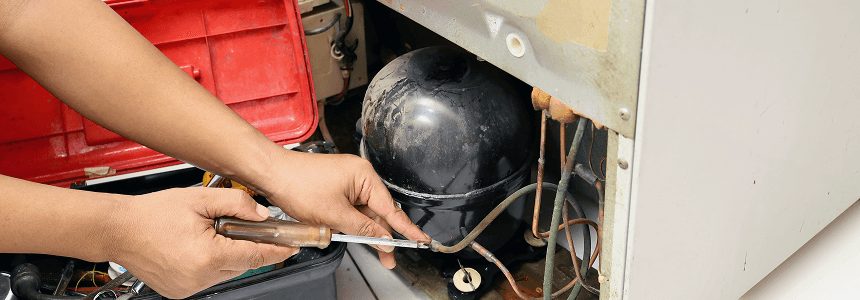
The compressor is the workhorse of the refrigerator. It helps move refrigerant through the appliance’s closed cooling system and facilitates the release of heat to ensure the fridge can maintain a cold temperature. Without a functioning compressor, your fridge is out of commission.
Of course, there are other possible causes of refrigerator breakdowns. This article will help you identify a malfunctioning compressor as the source of your refrigerator trouble and walk you through the next steps.
There’s a reason Liberty Home Guard was rated the #1 Home Warranty
Service by U.S. News and World Report for 2021, 2022, 2023, and 2024. Check out our services.
To understand why a refrigerator compressor is such an integral component, it helps to understand how a refrigerator works at its most fundamental level.
Refrigerators generate a cooling effect by cycling refrigerant through a closed loop. A compressor, as the name implies, compresses refrigerant gas to increase its pressure and temperature. As this hot, pressurized gas moves through the system, condenser coils at the rear of the fridge allow it to give off heat into the surrounding room. This is why it often feels warm behind the fridge.
As the gas cools, it transforms into a high-pressure liquid. The liquid refrigerant passes through an expansion valve, facilitating a swift drop in pressure and temperature. Now quite cold, the liquid travels through the evaporator coils and turns into a gas that can absorb the heat from within the fridge. This gas travels back to the compressor, where the cycle repeats.
Here is one way to think of it. Refrigerators don’t create the cold, but they do create a cooling effect by extracting the heat from the food and air within the fridge. The compressor is an essential piece to this feat of engineering. It is the component responsible for pressurizing the refrigerant gas and pumping it through the sealed system.
Faulty refrigerator compressors may present a number of problems. Be aware, however, that these problems don’t guarantee that the compressor is the problem. Other faulty components or even just dusty condenser coils can present similar symptoms.
If you have a refrigerator not cooling, compressor problems are a possibility. The compressor is integral to the cooling action of the refrigerator. If it’s not adequately pressurizing refrigerant to pump it through the refrigeration system, the fridge temp may run too high or fluctuate, or there may be no cooling at all.
The compressor doesn’t run constantly in a properly functioning refrigerator. The average fridge runs a cooling cycle for around 20 to 40 minutes before shutting off for roughly the same amount of time. If the compressor is running constantly, the refrigerator is struggling to maintain temperature, and the compressor may be faulty.
All refrigerators make noise, and you’re probably used to the quiet hum in the background of your house when the refrigerator is in the middle of a cooling cycle. Odd noises that catch your attention are often cause for concern. Buzzing, rattling, whining, and knocking could point to compressor failure.
A compressor that isn’t cycling properly can cause the fridge temperature to bounce up and down. You might find frost or partially frozen food one day and melted ice or thawed food in the freezer the next.
Short cycling is when an appliance turns on and off too frequently. You might hear your refrigerator’s compressor engage, only for it to shut off a few moments later.
If the fridge appears to be drawing power (based on the interior bulb or any indicator lights, for example) but isn’t running, the compressor may need to be replaced.
It’s normal for the rear of the fridge to feel warm, since the condenser coils are designed to give off heat. If the fridge feels unusually hot, however, the compressor may be overheating due to a mechanical or electrical failure.
Refrigerator repairs tend to be costly when the sealed system is involved. The cost of repairing or replacing a fridge compressor ranges from around $500 to $1,500. Here’s how that total breaks down:
Labor is the primary contributor to the high cost of repair because working on a refrigerator’s sealed system is specialized work. It involves handling potentially hazardous refrigerants, which requires EPA certification and in some cases additional state licensing.
Additional factors that can drive up the costs include:
Determining when to replace refrigerator compressor units or just get a new fridge entirely is sometimes a difficult question. Here are some factors to weigh.
There are some circumstances in which homeowners may be able to shield themselves from the high cost of refrigerator repair. One scenario is if the refrigerator is still protected by the manufacturer’s warranty. Many refrigerator manufacturers offer one- to three-year warranties that cover both parts and labor in the event of an appliance breakdown. Extended warranties are also common, in which the manufacturer will perhaps cover parts, but not labor, for a period of five to ten years after purchase.
Another way to minimize out-of-pocket expenses is to maintain equipment breakdown coverage from a third-party provider after the manufacturer’s warranty expires. Appliance repair from a third party typically entails a service fee and may have coverage caps, but the homeowner is protected from the full cost of repair or replacement.
There’s a reason Liberty Home Guard was rated the #1 Home Warranty Service by U.S. News and World Report for 2021, 2022, 2023, and 2024. Check out our services.
Learn MoreThe compressor is the heart of the fridge, and it’s built to last. On average, compressors should last for 12–15 years before failing.
Replacing the compressor can be worth the expense in some cases. When weighing refrigerator repair vs. replacement, consider the appliance’s age, make and model, and overall condition. A compressor replacement is probably worth it if the refrigerator is less than 8 years old, is a high-end make or model, and is in otherwise good condition. Skip the repair if the cost is more than 50% of what the fridge is worth.
A compressor is part of the refrigerator’s sealed system, which requires specialized repair. Technicians who are equipped to replace a fridge compressor handle refrigerant and must be EPA certified. Some states may have additional licensing requirements.
The compressor is a core component of a refrigerator’s cooling system. If the compressor isn’t working at all, the refrigerator is basically inoperable. A faulty or malfunctioning compressor may still enable the fridge to operate, but there might be insufficient cooling or other problem symptoms.
It is possible for a warranty to cover a refrigerator compressor, but it depends on the policy. Many providers do not offer sealed system coverage because of the specialization it entails. To explore refrigerator coverage options that can save you money in the event of an unexpected breakdown, ring the Liberty Home Guard team at (866)-950-6389.
Stay Ahead of Potential
Home Mishaps!
Subscribe to our Liberty Home Guard Newsletter and gain access to exclusive content that ensures your peace of mind.

Subscribe to receive our emails & get
Have questions?
Call us: (833) 544-8273