


Contemplating coverage?
Subscribe to receive our emails & get
$200 OFF!
Have questions?
Call us: (833) 544-8273

Expert-Reviewed Content: Guided by Editorial Standards

Written By Ellie Brooks
Your water softener runs quietly in the background, and that makes it easy to miss when something goes wrong. Most homeowners only notice a problem after weeks of degraded water quality. Catching it early saves money and protects your plumbing.
Before diving into the signs, check two things first: confirm the unit is plugged in and the circuit breaker has not tripped, and verify the bypass valve is set to the service (active) position. A tripped breaker or an accidentally engaged bypass valve are the two most common reasons a softener appears to stop working overnight. If both check out, read on.
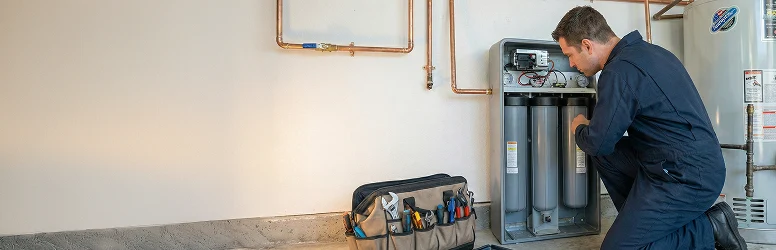
The express purpose of a water softener is to filter out hard minerals, such as calcium and magnesium, from home water. You will start to notice if your water turns hard, that is, if the dissolved mineral content increases. When you wash your hands or bathe, you might notice that you need to scrub harder with soap to get a good lather. Hard water reacts with soap to form soap scum, which you could see accumulate on the surfaces of your shower or tub. Soap scum can also leave a film on your skin. Other signs of hard water include spots and streaks on your plates, glasses, and silverware and mineral stains on your laundered clothes.
According to the U.S. Geological Survey (USGS),water hardness above 7 grains per gallon contributes to the scale, soap scum, and fixture staining that signal your softener may not be working.
If your water feels too hard, consult a water softener troubleshooting guide. Here are a few potential causes:
You can confirm hard water by using an inexpensive water hardness test strip, available at most hardware stores or online. A reading above 1 grain per gallon (17 mg/L) from a tap running through your softener indicates the unit is not removing minerals effectively.
A healthy water softener will naturally make some noise when it undergoes a regeneration cycle. You might hear the gentle hum of the motor, periodic gurgling of water, or the ticking of the water softener's timer. These sounds are normal and indicate the system is actively treating your water.
Depending on your water softener's size and design, you might hear a regeneration cycle every few days or once every one to two weeks. If you don't notice any noise over an exceptionally long stretch of time, you should check on your appliance and service it as needed. Prolonged silence can mean the unit has stopped regenerating entirely, which may be caused by a failed timer, a tripped breaker, or a depleted salt supply.
Also keep an ear out for unusual noises. Hissing or high-pitched squealing can indicate a faulty valve or damaged pipe or hose. If your water softener is hissing, check the bypass valve to make sure it is fully open, and inspect visible tubing for cracks or loose fittings. If hissing continues, the control valve or O-rings may need professional inspection. Grinding, banging, or other loud noises can be due to mechanical malfunctions or mineral buildup. A grinding sound often points to a worn motor or debris caught in the valve assembly; if the noise persists, consider scheduling a service call before the motor fails entirely. Trickling noises suggest a leak, but you will presumably notice the pooling water as well. A constant trickle outside of a regeneration cycle usually means a valve is not seating properly and may need replacement.
If any of these sounds accompany a loss of soft water, the issue likely involves mechanical damage covered under equipment breakdown coverage.
If you've lived in your home for several years, you should have some frame of reference for how much salt your softener requires from month to month. It's a red flag if you find yourself using more or less salt than you're accustomed to.
Troubleshoot water softener salt consumption issues by checking your timer and settings. If you're consuming salt too quickly, you may have inadvertently set your softener to engage a regeneration cycle too frequently. An unideal regeneration timer setting could also be why you're going through salt too slowly.
Also, if your softener appears to be full of salt, consider the possibility of a salt bridge. This is a cake or crust of salt that forms above the water level. Salt bridges are very common. Simply break it up with a broomstick or other long tool. Extract and discard any chunks that look too large to dissolve in the water.
As a maintenance note, avoid filling the brine tank beyond the halfway point. Overfilling can encourage salt bridges and mushing, both of which interrupt the regeneration process.
A common question homeowners ask is: "Should there be water in my water softener?" The answer is yes, but only a small amount. The water level in your softener's brine tank should usually be quite low. There should not be enough water to fully submerge the salt. A water softener full of water could be due to a malfunctioning float switch. Another possibility is a drain line that is pinched or clogged with mineral buildup.
Poor water pressure could be a sign of a water softener malfunction. To confirm your softener is the source of the problem, engage the bypass valve, then check the water pressure in your kitchen or bathroom. If the pressure is greater than it was previously, your softener is causing the problem. Check the appliance's internal filter. If you hadn't replaced it in some time, it is likely clogged, inhibiting waterflow.
If low water pressure is a chronic issue, you water softener could be too small for your home. It could also be that minerals or resin beads have accumulated in your showerheads and faucets.
There's a reason Liberty Home Guard was rated the #1 Home Warranty Service by U.S. News and World Report for 2021, 2022, 2023, and 2024. Check out our services.
Learn MoreDiscolored water or visible resin beads in your tap water indicate a problem inside the softener that should not be ignored. Discolored water could have a number of causes, one of which is rust buildup in your water softener. If you notice brown or orange water, check your brine tank for signs of corrosion or dirt.
You also may notice tiny resin beads in your water. These can damage your plumbing and fixtures over time and should not be able to escape the tank. If you notice resin beads, confirm that your internal water softener screen is not torn. Before replacing the resin bed, try a resin cleaner such as Iron-Out, which can restore performance in cases where the beads are fouled by iron or manganese rather than physically worn. Resin beads typically last 10 to 15 years; if your unit is in that range and still releasing beads after cleaning, the resin bed likely needs replacement. For more information on coverage for these types of repairs, see our water softener coverage page.
Water softeners should be cleaned once every year or two. If you're noticing the odor of sulfur in your water or in the softener itself, you probably need to clean your brine tank to remove the accumulation of bacteria. Consult your owner's manual or contact a professional as needed.
Water softeners are complex systems that can develop various issues over time. Understanding these problems helps you identify what you can fix yourself and when professional service is needed.
Problem | Likely Cause | Fix |
Water feels hard | Salt bridge, bypassed valve, or empty brine tank | Break up salt bridge; check bypass valve; add salt |
No regeneration | Failed timer, tripped breaker, or depleted salt | Check power; inspect timer settings; refill salt |
Low water pressure | Clogged internal filter or resin beads in fixtures | Replace filter; flush showerheads and faucets |
Brine tank overfilling | Stuck float switch or clogged drain line | Inspect and clear drain line; replace float switch |
Resin beads in water | Torn internal screen or worn resin bed | Replace screen; treat with resin cleaner or replace resin |
Hissing noise | Faulty valve, damaged hose, or high pressure | Inspect bypass and control valves; check O-rings |
High salt use | Regeneration set too frequently | Adjust regeneration timer settings |
Discolored water | Rust or iron fouling in brine tank | Clean brine tank; use Iron-Out for resin fouling |
Before any other troubleshooting, confirm two things. First, check whether the softener is plugged in and the outlet is live; a tripped breaker can stop the unit from working entirely. Reset the breaker if needed, then confirm the display powers on. Second, verify the bypass valve is set to the service position, not the bypass position. If the bypass valve is engaged, water will skip the softener entirely, and no amount of adjustment will restore soft water until it is returned to service mode.
Safety note: If you are not comfortable checking electrical components, contact a licensed technician.
If both power and bypass check out, proceed to inspect the brine tank, salt level, and timer settings before calling for service.
If you notice white or chalky buildup on your faucets, showerheads, or appliances, this could indicate your water softener is not effectively removing hard minerals. This scaling can reduce water flow and efficiency while potentially damaging your plumbing system over time.
While some noise is normal during regeneration cycles, certain sounds can indicate problems. A water softener hissing persistently might signal a pressure issue or valve problem. If you hear a continuous water softener making noise outside its normal regeneration cycle, this could indicate:
Modern water softeners should be highly efficient with salt usage. If you notice irregular salt consumption, check these often-overlooked areas:
If resin beads are fouled by iron or manganese, a dedicated resin cleaner may restore softening performance without the cost of full resin replacement. Iron- or manganese-fouled resin can reduce softening performance significantly, and products like Iron-Out are formulated for this type of fouling. If cleaning does not restore performance, the resin bed itself may need replacement, particularly in units over 10 years old.
Many contemporary water softeners feature electronic controls. If your display shows error codes or isn't functioning correctly, this could indicate:
Consult your unit's manual to decode specific error codes. In many cases, a power cycle (unplugging the unit for 30 seconds and restarting it) will clear a transient error. Persistent codes typically indicate a component failure that requires a service call.
Not every water softener problem requires a full replacement, but some repairs are beyond DIY scope and some units are simply past their useful life.
The 50% rule: If the cost of repairing your softener exceeds 50% of the cost of buying a comparable new unit, replacement is typically the better long-term value. Apply this especially if the unit is already 8 or more years old.
Age trigger: Units over 10 years old that require recurring repairs are usually better candidates for replacement than continued service. Repair costs will likely continue to accumulate.
Repairs that exceed DIY scope include:
For these situations, call a licensed plumber or water treatment specialist. And if repair or replacement costs catch you off guard, water softener coverage through a home warranty plan can protect you from unexpected out-of-pocket expenses.
Some water softener problems are quickly and cheaply resolved. Others require expensive replacement parts of several hours of skilled labor to remedy. Protect yourself from surprise costs with a home warranty from Liberty Home Guard. Our water softener coverage will protect all mechanical parts that are necessary for the unit to function properly.
Request a free quote through our website or call (866)-432-1283 to learn more.
There's a reason Liberty Home Guard was rated the #1 Home Warranty
Service by U.S. News and World Report for 2021, 2022, 2023, and 2024. Check out our services.
The average lifespan of a water softener is 10-15 years (Water Quality Association),though this can vary based on water quality, usage patterns, and maintenance. Systems that process particularly hard water or high volumes may need replacement sooner. Regular maintenance and timely repairs can help extend your unit's lifespan significantly.
Common signs of a clogged water softener include decreased water pressure, visible sediment in your water, irregular regeneration cycles, and poor water quality. You might also notice the system using more salt than usual or producing less soft water. Check the brine tank, resin bed, and valve assembly for buildup or blockages.
A hissing noise from your water softener often indicates a pressure problem or valve issue. This could be caused by:
Consider replacement if you notice multiple of these signs:
A water softener stops working for several common reasons: a salt bridge blocking the brine tank, low or depleted salt levels, the unit set to bypass mode, a tripped circuit breaker, a clogged injector or brine line, a failed control valve, or worn resin beads. Most issues can be diagnosed with a visual inspection and a water hardness test.
To reset most water softeners, start with a power cycle: unplug the unit, wait 30 seconds, then plug it back in. Once power is restored, check that the time of day is set correctly on the control head, as an incorrect clock can cause regeneration to run at the wrong time or not at all. To manually initiate a regeneration cycle, press and hold the regeneration button on the control head for 3 to 5 seconds. Specific steps vary by brand; consult your owner's manual for model-specific instructions.
Stay Ahead of Potential
Home Mishaps!
Subscribe to our Liberty Home Guard Newsletter and gain access to exclusive content that ensures your peace of mind.

Subscribe to receive our emails & get
Have questions?
Call us: (833) 544-8273