


Contemplating coverage?
Subscribe to receive our emails & get
$300 OFF!
Have questions?
Call us: (833) 544-8273

Expert-Reviewed Content: Guided by Editorial Standards

Written By Angel Vallejo
A garage door is the largest moving part in most homes and usually the biggest single surface on the front of the house. When it fails, the bill sits somewhere between a weekend repair and a small renovation. In 2026, the typical garage door replacement cost runs $750 to $3,500installed, with most homeowners landing near $1,200 to $1,900. Four variables decide where you fall: size, material, insulation, and local labor rates.
Two homes on the same street can get quotes $2,000 apart, and neither contractor is wrong. One is quoting a 9x7 non-insulated steel single. The other is quoting a 16x8 insulated double with windows.
Item | Cost |
|---|---|
National average, installed | $1,200 to $1,900 |
Typical range | $750 to $3,500 |
Low end | $500 to $750 (basic steel single, simple swap) |
High end | $4,000 to $10,000+ (custom wood or full-view glass double) |
Door and hardware only | $400 to $2,800 |
Labor | $300 to $600 (3 to 6 hours) |
Old door removal and haul-away | $50 to $150 |
Three costs hide inside most quotes and are worth asking about directly. New torsion springs are usually included on a full replacement but occasionally itemized at $150 to $350. Track replacement adds $125 to $300 when the existing tracks are bent or the wrong radius for the new door. Permit fees apply in some municipalities, typically $50 to $150.
Material is the second-largest cost driver after size, and it determines almost everything about how the door ages.
Material | Door only, single | What to know |
|---|---|---|
Non-insulated steel | $400 to $900 | Cheapest option, dents from basketballs and bumpers |
Insulated steel | $700 to $1,800 | The volume seller, R-6 to R-18 depending on layers |
Aluminum and glass | $1,000 to $3,500 | Modern look, weak insulation unless you upgrade the glazing |
Fiberglass | $800 to $2,000 | Resists rust and salt air, can yellow after a decade |
Vinyl | $900 to $2,200 | Dent resistant, limited color range |
Wood composite | $800 to $2,400 | Wood appearance without annual refinishing |
Solid wood | $1,200 to $5,000+ | Highest cost, needs refinishing every two to three years |
Insulated steel is the default recommendation for most homes, and not only for energy reasons. A two or three-layer door is stiffer, quieter, and holds its shape better than a single-layer panel, which matters over 15 to 20 years of daily cycles. The upgrade from non-insulated to insulated steel typically adds $200 to $800.
Wood is the one material where the purchase price understates the real cost. Refinishing runs $200 to $600 every few years, and a neglected wood door in a wet climate can fail in half the lifespan of steel.
Size is the number that moves the quote most, because it changes the panel count, the spring assembly, and the crew time all at once. Here are common garage door sizes and prices, installed.
Size (W x H) | Type | Installed cost |
|---|---|---|
8’ x 7’ | Single | $600 to $1,300 |
9’ x 7’ | Single | $700 to $1,600 |
10’ x 8’ | Oversized single | $900 to $2,000 |
12’ x 7’ | Oversized single | $1,000 to $2,300 |
16’ x 7’ | Double | $1,100 to $3,000 |
16’ x 8’ | Double | $1,300 to $3,400 |
18’ x 8’ | Oversized double | $1,500 to $4,000 |
Most single doors land between $600 and $1,600 installed. The 9x7 is the most common size in American housing stock, which means it is also the size with the deepest inventory of in-stock panels. Choosing a standard size off the shelf instead of a custom order can save $300 to $700 and cut the lead time from six weeks to a few days.
A double garage door price generally falls between $1,100 and $3,400 installed for a standard 16-foot opening. Doubles are not simply twice the material. They need a heavier spring system, a reinforced center strut, and often a higher-horsepower opener to handle the added weight. If you have two separate single doors rather than one double, expect two complete installs and two openers.
Timing matters too. Late fall and winter are slower for most installers, and quotes tend to soften. Spring is peak season and peak pricing.
Here is the honest boundary, because it saves a frustrating claim call later. A home warranty does not pay to replace the door panel itself. Panels and glass are treated as structural and cosmetic, and damage from a vehicle, a storm, or a stray hailstorm belongs to your homeowners insurance policy.
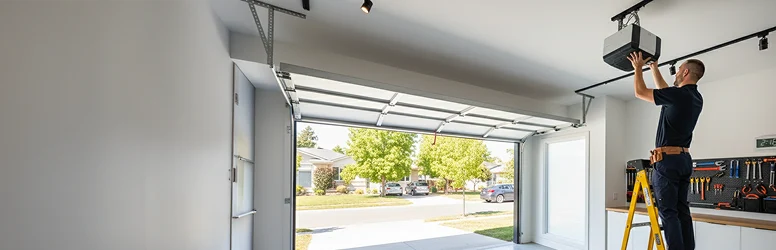
What a warranty does cover is the part that actually breaks most often: the operating system. Liberty Home Guard’s garage door opener coverage is included across our plans and protects the mechanical and electrical components that fail from normal wear, including:
When one of those fails, you file a claim, pay your service call fee, and a licensed technician handles the repair or replacement up to your plan’s coverage limit. Our full breakdown of what a home warranty covers on a garage door walks through the exclusions and caps in detail.
One practical note before you call anyone: a door that reverses unexpectedly or refuses to close is often a sensor alignment issue, not a failed motor. Our guide to fixing common garage door opener problems covers the five-minute checks worth doing first.
Often yes, and it typically costs $250 to $800 per panel including labor. The limitation is availability. Manufacturers discontinue panel styles every few years, so a door older than about a decade may have no matching replacement. Even when a panel is available, slight color fade on the surrounding sections can make the repair visible from the curb.
A standard single-door swap takes three to five hours. A double runs four to six. Most crews complete the job in one visit. Expect longer if the jambs need repair, the opening is out of square, or the installer is also mounting a new opener. Plan to keep vehicles out of the garage for the full day.
Usually, for reasons beyond temperature. An insulated door is noticeably quieter in operation and structurally stiffer, so it resists dents and warping better over time. If the garage shares a wall or ceiling with living space, insulation also reduces heat transfer into those rooms. For a detached, unattached garage used purely for storage, the case is weaker.
Not automatically, but check the weight. A half-horsepower opener sized for a lightweight non-insulated door can struggle with a heavier insulated replacement, and an overworked motor fails early. Also confirm your opener has photo-eye safety sensors. Units manufactured before 1993 lack them and should be replaced regardless of door condition.
Consistently, yes. Garage door replacement ranks near the top of national cost-versus-value studies year after year, frequently recouping most or all of its cost at resale. The reason is visibility. The door can occupy a third of a home's front elevation, so replacing a dented, faded one changes the first impression a buyer forms before they reach the driveway.
Stay Ahead of Potential
Home Mishaps!
Subscribe to our Liberty Home Guard Newsletter and gain access to exclusive content that ensures your peace of mind.

Subscribe to receive our emails & get
Have questions?
Call us: (833) 544-8273