


Contemplating coverage?
Subscribe to receive our emails & get
$300 OFF!
Have questions?
Call us: (833) 544-8273

Expert-Reviewed Content: Guided by Editorial Standards

Written By Angel Vallejo
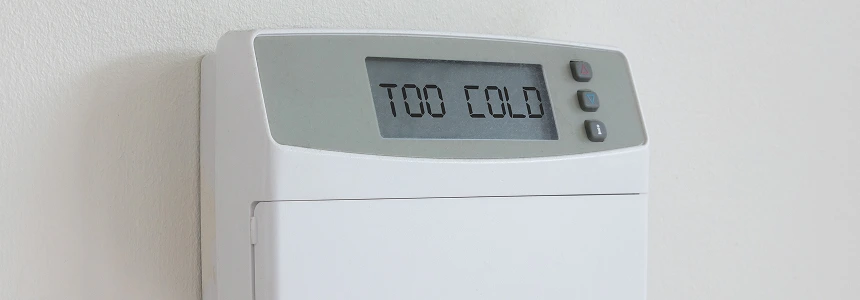
When your heater stops working on a cold day, the cause is often something small that you can find and fix in a few minutes. Other causes need a licensed technician, and a few are dangerous enough that you should leave the house right away. This guide walks through safe checks for furnaces, heat pumps, boilers, and portable heaters, and it explains when it is time to call a professional.
Heating equipment causes real harm when it fails or is misused. The National Fire Protection Association estimates that U.S. fire departments responded to about 40,997 heating-equipment fires a year from 2018 to 2022, with about 470 civilian deaths a year. Peer-reviewed research also finds that more than 200 people die each year in the U.S. from carbon monoxide poisoning in homes, and about two-thirds of those deaths are linked to heating equipment. The U.S. Consumer Product Safety Commission reports that portable heaters were involved in an average of 1,600 fires a year from 2020 to 2022, causing about 70 deaths and 150 injuries a year.
Before you try any fix, keep these rules in mind:
The right fix depends on what kind of heater you have, so start by finding out which one is in your home.
If your problem is a lack of hot water at the tap and not a lack of heat in the house, see our hot water heater not working guide instead.
These three checks apply to nearly every central heating system, and they solve a large share of no-heat calls.
If the quick checks did not help, work through the section that matches your heater.
Gas furnaces are the most common central heater in the U.S. Confirm that the gas supply valve to the furnace is open and that other gas appliances, such as your stove, are working. If you recently had a gas interruption, relight a pilot light only if you do not smell gas and you follow the manufacturer’s instructions exactly.
If you can see the burner through the small sight glass, watch what happens when the thermostat calls for heat. A normal cycle begins with the inducer fan starting, then the ignitor glowing or sparking, then the burners lighting, and finally the blower starting. Where the cycle stops tells you a lot, and it is useful information to give a technician.
Some causes are within reach of a homeowner: a clogged filter, a blocked intake or exhaust pipe (the white PVC pipes that run outside),a thermostat setting, a tripped switch or breaker, or a full condensate drain that has triggered a safety switch. For more on cold air from a furnace, read why your furnace may be blowing cold air.
Leave these to a professional: a failed ignitor, a dirty or failed flame sensor, a faulty pressure switch, control board errors, gas valve problems, and repeated short cycling.
Start with the breaker. Electric furnaces draw a lot of power, and they often use more than one breaker. Replace the filter and confirm that the thermostat is set to Heat. If the unit has a high-limit reset button that you can reach, you can press it once, but a unit that trips again needs service.
A technician should handle failed heating elements, a bad sequencer, control board faults, and a failed high-limit switch.
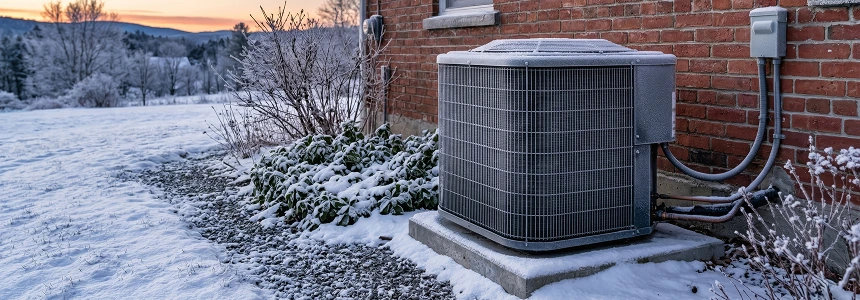
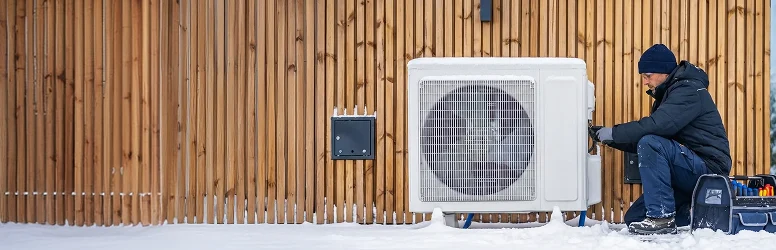
A heat pump can build up light frost in cold weather, and that is normal because the unit defrosts itself. Thick ice that stays for hours is not normal and points to a defrost problem or poor airflow. If the outdoor unit is iced over, switch the thermostat to Emergency Heat to keep the house warm until a technician arrives. Emergency Heat uses electric heating elements, so it can raise your power bill.
Clear snow, leaves, and debris from around the outdoor unit, and keep a few feet of open space on every side. In very cold weather, confirm that the auxiliary heat turns on when the heat pump cannot keep up.
Call a professional for defrost board or sensor faults, a low refrigerant charge, or a reversing valve problem.
Confirm that the thermostat is calling for heat, that the boiler has power, and that the pressure gauge is in the range the manufacturer lists. If radiators are cold at the top but warm at the bottom, air is trapped inside, and bleeding them with a radiator key usually fixes it. If you have more than one heating zone, check that the zone valves are set correctly.
A professional should handle a failed circulator pump, a low-water cutoff problem, pilot or ignition faults, and expansion tank or pressure problems. Our guide to circulation pump troubleshooting explains the signs of a failing pump. Note that boilers and other hydronic systems are generally excluded from standard HVAC coverage, so check your agreement before you assume a repair is covered.
Check that the outlet works, the heater is upright so the tip-over switch is not engaged, and the thermostat dial is turned up. Vacuum the intake grille if it is dusty. Do not use a heater with a frayed or damaged cord, do not run it while you sleep, and keep it 3 feet away from anything that can burn.
Replace the filter and open every vent first. If one room is too warm, partially close its register to send more air to colder rooms. Look at any ductwork you can see for kinks, loose connections, or obvious leaks, and seal small gaps with foil tape made for ducts. Check whether a damper or zone control is stuck closed. Duct repairs and zoning faults need a professional.
A heater that never shuts off may have the thermostat fan set to On instead of Auto. Other causes include a very dirty filter, large air leaks in the home, a system too small for the house, or, on a heat pump, a low refrigerant charge.
A heater that turns on and off every few minutes is short cycling. It usually happens because the unit overheats from a clogged filter or blocked vents, or because of a dirty flame sensor or a pressure switch problem. Replace the filter and clear the vents. If the short cycling continues, schedule service.
Call a licensed technician if you notice any of the following:
Even when nothing is wrong, have a professional service your heating system once a year, ideally before the heating season starts.
A heating repair or replacement can be a large, unplanned expense. With eligible coverage, Liberty Home Guard can send a licensed professional to your home, and you pay a service fee for each approved claim instead of the full cost of the repair. If a covered system cannot be repaired, your agreement may provide for replacement.
HVAC Guard is built specifically for heating and cooling problems. It has no waiting period, and it allows pre-existing conditions. Heating system coverage is also part of Systems Guard. Water heaters are covered under Systems Guard and Total Home Guard for mechanical and electronic components, up to the limits in your agreement. Other plans generally begin 30 days after purchase.
It helps to know what a warranty does not cover. Coverage applies to normal wear and tear on eligible systems and components. Improper installation, lack of maintenance, and inaccessible items are generally excluded. Pre-existing conditions are allowed under HVAC Guard, but other plans may exclude them, so check your agreement. Certain parts are also excluded, including cracked heat exchangers, hydronic or steam systems and boilers, evaporator coils and drain pans, dampers, radiant heating, geothermal and water-source systems, outside piping, fuel storage tanks, fireplaces, and portable units. For water heaters, the tank itself and sediment buildup are often excluded.
Review your own agreement for waiting periods, exclusions, and coverage limits. You can read a sample policy to see the typical terms.
Protect What’s Most Important With
Get A Free Quote
America’s #1 Home Warranty
Check the thermostat mode and batteries, raise the temperature setting, and make sure the furnace switch and breaker are on. Confirm that the furnace panel is closed securely, and replace a dirty filter. If the heater still does not start, call a professional.
The thermostat may be set incorrectly, the furnace may be overheating because of a clogged filter, or there may be an ignition problem. Replace the filter, confirm the settings are Heat and Auto, and try again. If the air stays cold, you need a technician.
Turn off power at the furnace switch or breaker for 5 minutes, then turn it back on. Set the thermostat to Heat and Auto and call for heat. If the furnace shuts down again, stop and call a professional.
Only if you do not smell gas and you follow the manufacturer's instructions exactly. If you smell gas or are unsure, leave the house and call your gas company or a professional.
Short cycling usually comes from restricted airflow, a dirty flame sensor, or a pressure switch problem. Replace the filter and check that the vents are open. If it continues, schedule service.
Yes. Install detectors on every level of your home and near sleeping areas, and test them monthly. Carbon monoxide has no color or smell, and a working detector is often the only warning you will get.
Stay Ahead of Potential
Home Mishaps!
Subscribe to our Liberty Home Guard Newsletter and gain access to exclusive content that ensures your peace of mind.

Subscribe to receive our emails & get
Have questions?
Call us: (833) 544-8273
