


Contemplating coverage?
Subscribe to receive our emails & get
$300 OFF!
Have questions?
Call us: (833) 544-8273


Expert-Reviewed Content: Guided by Editorial Standards

Written By Ben Joseph
An air conditioner that won’t power on might have a simple explanation. Before you call a pro, first perform some basic AC troubleshooting.
If you still can’t turn the cool air on, proceed to investigating the condensate drain line for a clog, replacing or cleaning the air filter, or checking internal electrical components. Depending on your appetite for DIY work, you may need the help of a technician.
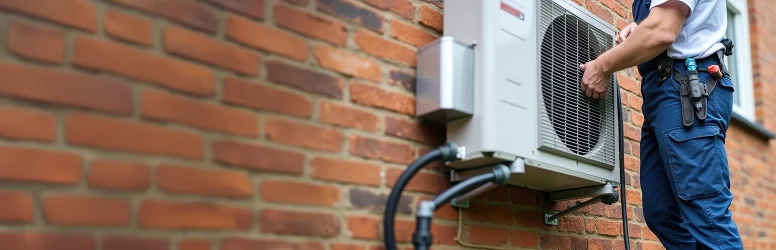
While an air conditioner can fail for any number of reasons, there are five issues in particular that account for most malfunctions.
The problem: ACs use a lot of power, especially upon startup when the compressor engages. If there are too many appliances drawing power from the same circuit, or if there’s a power surge, the breaker may trip as a safety measure.
How to solve it: Reset the breaker at the electrical panel to restore power. Move the tripped breaker from the center position to “off,” then flip it back to “on.” If the breaker continues to trip and you aren’t overloading the circuit with too many appliances, have an electrician troubleshoot.
The problem: An unresponsive or bad thermostat stops you from controlling your air conditioner. It’s also possible that the thermostat is functional, but the settings need to be checked.
How to solve it: Confirm that your thermostat is set to “cool” and the desired temperature is cooler than the current room temperature. If you have an AC not responding to thermostat inputs, check that the batteries or in-wall wires are in good condition. If your home uses a smart thermostat, confirm that it’s connected to Wi-Fi. You can also reset the thermostat per the manufacturer’s recommendations.
The problem: The moisture that an air conditioner extracts from the air flows out of the appliance through a condensate drain line. Over time, this line can become clogged with algae, mold, or fine debris, causing water to back up into the drain pan and triggering a float switch that shuts the system down.
How to solve it: Confirm a clog by examining the indoor end of the drain line and checking the drain pan for pooling water. Use a wet/dry vacuum at the outside end of the line to clear the obstruction.
The problem: An AC’s capacitor delivers a charge to jumpstart the compressor and fan. If it fails, the AC can’t function properly.
How to solve it: Replacing a capacitor can be a dangerous job because the component stores an electrical charge even when the appliance is powered off. It’s best to leave the work to a professional.
The problem: A contactor is a specialized relay switch that receives a low-voltage signal from the thermostat and turns on the high-voltage power to the compressor and fan motor. When a contactor corrodes or becomes stuck in the open state, the AC won’t work.
How to solve it: A faulty contactor needs to be replaced. The component itself is not particularly expensive, but there is again the risk of electric shock because of the nature of the work. Calling a technician is the best move.
Understanding how the various mechanisms in your AC system fail can help you resolve a breakdown more quickly and effectively.
Some routine AC maintenance will help you go longer before experiencing a breakdown. Here are the basics:
But remember that your home warranty provider can advise on whether repair or replacement is the best course of action. All you need to do is make a claim when you experience a breakdown, and you can have a technician diagnose the problem and recommend next steps. To learn more about Liberty Home Guard’s award-winning service, call (866)-983-0940.
A dirty filter is usually a performance problem and doesn’t prevent the AC from turning on, but an especially dirty filter could inhibit airflow to such an extent that the compressor and fan motor shut down to prevent overheating.
A dirty filter is usually a performance problem and doesn’t prevent the AC from turning on, but an especially dirty filter could inhibit airflow to such an extent that the compressor and fan motor shut down to prevent overheating.
Reset your AC system by turning it off at the thermostat, then cutting power to the circuit at the breaker box. Flip the breaker to “off” and wait one minute before turning it back to the “on” position. Then return to the thermostat and set the system to “cool.”
Faulty electrical components in an AC can draw too much power and trip a breaker. The breaker will also trip if too many appliances are running on the same circuit. The problem could also reside within the electrical system itself, and the circuit may be too old or damaged to handle an AC’s power demands.
Capacitors and contactors are usually worth replacing, but if the compressor fails, it might be worth replacing the entire appliance. As a rule of thumb, plan on replacement if the appliance is more than 10 to 15 years old, or if the repair costs exceed 50% of the price of a new unit.
Stay Ahead of Potential
Home Mishaps!
Subscribe to our Liberty Home Guard Newsletter and gain access to exclusive content that ensures your peace of mind.

Subscribe to receive our emails & get
Have questions?
Call us: (833) 544-8273