



Contemplating coverage?
Subscribe to receive our emails & get
$300 OFF!
Have questions?
Call us: (833) 544-8273


Expert-Reviewed Content: Guided by Editorial Standards

Written By Angel Vallejo
The white crust on your showerhead is not dirt. It is rock.
Calcium and magnesium travel dissolved in your water supply, and they leave a little of themselves behind on every surface they touch. Fixtures. Pipe walls. The heating element inside your water heater. Most homeowners notice the symptoms years before they name the cause. Cloudy glassware. Stiff towels. Soap that refuses to lather. Skin that feels tight after a shower.
Let’s be honest. Hard water never feels like an emergency. It just shortens the life of equipment you paid real money for, then sends the bill years later.
That is where a water softener earns its place.
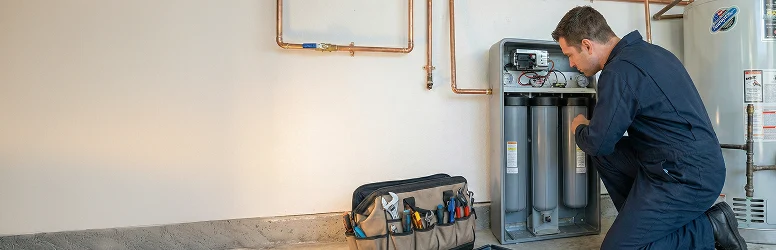
A water softener is a whole-home treatment system that removes the dissolved calcium and magnesium responsible for water hardness. It installs on your main water line and treats water before it reaches a single tap. The process behind it carries a technical name, ion exchange, but the mechanics are simple.
Inside the resin tank sit thousands of tiny, negatively charged resin beads. Hard water flows through, and the positively charged hardness minerals cling to those beads. In their place, the system releases a small amount of sodium or potassium. Water leaves the tank without the minerals that build scale.
The beads fill up eventually. When they do, the softener runs a regeneration cycle, flushing the resin with a brine solution drawn from a second tank, rinsing the captured minerals down the drain, and recharging the beads for the next round. Better systems regenerate based on metered water use instead of a fixed schedule, which saves both salt and water.
Two tanks. One mineral trade. That is the whole concept.
Hard water will not hurt you. It will cost you.
The U.S. Geological Survey classifies water above 7 grains per gallon as hard, and a large share of American homes sit well above that line. At those concentrations, minerals plate out inside your water heater and drag down its efficiency, narrow the interior of aging pipes, and leave the film you scrub off shower doors every weekend. Dishwashers work harder. Washing machines wear out sooner. Detergent gets poured in heavier doses to do the same job.
Soft water changes the daily experience right away. Soap lathers with less product. Glassware dries clear. Laundry comes out softer. Hair and skin stop feeling coated after a rinse.
The hard water vs soft water difference is easiest to feel in the shower and easiest to see on the dishes.
None of that is cosmetic. Every symptom on that list points to the same slow erosion of appliances you expect to keep for a decade.
Look at the surfaces your water touches most.
Chalky buildup around faucet aerators and showerheads is the clearest tell. Soap scum on tile and tubs is the second. Add spotty glassware straight out of the dishwasher, laundry that feels stiff after drying, and a water heater that recovers more slowly than it used to, and you have a strong case before spending a dollar.
Then confirm it with a number. A hardness test strip from any hardware store costs a few dollars and delivers a reading in grains per gallon in under a minute. If your home draws from a municipal supply, your utility publishes an annual water quality report that lists hardness. Well owners should go further and use a certified lab, because wells often carry iron and sediment alongside hardness, and those problems call for different equipment.
Read your result against a simple scale. Under 3.5 grains per gallon counts as soft to slightly hard. Between 3.5 and 7 is moderately hard. Above 7 is hard, and above 10.5 is very hard. The higher that number climbs, the faster your appliances pay for it.
Sizing beats branding. Every time.
Start with your hardness reading and your household size. Multiply the number of people in your home by roughly 75 gallons of daily use, then multiply that figure by your grains per gallon. The result is your daily grain load, and it tells you what capacity the system needs to carry without regenerating constantly. Many households of three to five people land in the 32,000 to 48,000 grain range, though your own test decides the final answer.
Next, look at how the unit regenerates. Metered systems trigger a cycle based on actual water use, which wastes less salt and less water than a timer that runs on schedule whether your household needed it or not. Ask for NSF/ANSI 44 certification, check the warranty terms on the resin tank and the control valve, and confirm the drain requirements before you buy.
One clarification saves people real money here. A salt-free "softener" is not a softener. Those systems condition water by changing how minerals crystallize, so scale wipes away more easily, but the calcium and magnesium stay in the water. They serve homes in areas with brine discharge restrictions. They do not produce softened water.
Finally, hire a professional to install it. The job involves cutting into your main line, adding a bypass valve, and running a drain line to code. A well-maintained system lasts 10 to 15 years, and a rushed installation is the fastest way to cut that number in half.
Here is the part most guides skip.
A water softener never announces its own failure. It keeps humming while a salt bridge hardens above the water line in the brine tank, or the bypass valve sits in the wrong position, or the injector clogs. Weeks pass before the spots on your glasses tell you anything changed. Check the salt level monthly, break up any crust you find, and keep the brine tank no more than half full to discourage bridging.
When hard water symptoms return, work through the common signs your water softener is not working properly before you assume the unit is finished. Plenty of failures come down to salt, settings, or a tripped breaker.
Some do not. Control valves fail. Motors burn out. Resin wears down.
Most standard home warranty plans leave water softeners out of base coverage, since the equipment is not present in every home. Manufacturer warranties expire, often within a year on labor. Homeowners insurance answers for sudden events like fire and storm damage, not for a control valve that wore out after eight years of hard use. That gap is exactly where an unexpected repair bill finds you.
Liberty Home Guard closes it with water softener warranty coverage as an optional add-on to a home warranty plan. When a covered component breaks down from normal wear and tear, you file a claim online or by phone, any hour, any day of the year. A vetted local technician handles the diagnosis and the repair.
Our plans reach homeowners in all 50 states and Washington, D.C. U.S. News & World Report has rated Liberty Home Guard the #1 home warranty company for 2021, 2022, 2023, 2024, and 2026. Those ratings measure how a company handles the claim you actually file, which is the only measure that counts on the day your softener quits.
Hard water works slowly, and so does the damage it leaves behind. A softener protects the appliances you already own. The right coverage protects the softener.
Take a hardness reading this week, and if the number surprises you, get a free quote or call our team at (866) 699-4589. We will help you cover what matters.
Protect What’s Most Important With
Get A Free Quote
America’s #1 Home Warranty
No. Softening and filtration solve different problems. A softener removes hardness minerals through ion exchange, but it leaves chlorine taste, sediment, and most contaminants untouched. Homeowners who want better-tasting drinking water usually pair a softener with a carbon filter or an under-sink reverse osmosis system. The two technologies complement each other, and many households run both without any conflict.
No. The system trades hardness minerals for a small amount of sodium that stays proportional to your water's original hardness, nothing close to a spoonful of table salt. Most people notice a smoother feel rather than a salty flavor. If anyone in your home follows a sodium-restricted diet, ask your installer about potassium chloride pellets or a separate reverse osmosis tap for drinking and cooking.
That depends on your hardness level, household size, and regeneration settings. Many families go through one to two 40-pound bags a month. Check the brine tank every four weeks, keep it between one-third and one-half full, and use the pellet grade your manufacturer recommends. Rock salt with high insoluble content leaves residue behind that shortens the life of your control valve.
Often yes, and often more urgently than a city-water home. Well supplies frequently test harder and carry iron, manganese, or sediment that fouls softener resin. Test the well before buying any equipment. Depending on the results, a sediment or iron filter installed ahead of the softener protects the resin bed and keeps the whole system performing the way it should.
That combination makes sense. Tankless units heat water across a narrow heat exchanger, and scale accumulates there faster than it does in a storage tank. Many manufacturers require annual descaling to keep the warranty valid. Softened water slows that buildup, protects the exchanger surface, and cuts down how often a technician needs to flush the unit.
Stay Ahead of Potential
Home Mishaps!
Subscribe to our Liberty Home Guard Newsletter and gain access to exclusive content that ensures your peace of mind.

Subscribe to receive our emails & get
Have questions?
Call us: (833) 544-8273