



Contemplating coverage?
Subscribe to receive our emails & get
$300 OFF!
Have questions?
Call us: (833) 544-8273


Expert-Reviewed Content: Guided by Editorial Standards

Written By Angel Vallejo
Knowing when to replace your HVAC system is one of the most important and most expensive decisions a homeowner will make. Most people are familiar with the generic advice: systems last 15 to 20 years, so start planning around year 12. But that rule of thumb leaves out something critical — where you live can change the math significantly.
At Liberty Home Guard, we process home warranty claims across all 50 states. The data we collect on HVAC breakdowns, repair frequency, and system failures paints a picture that’s a lot more specific than the generic advice suggests, and in some states, a lot more urgent.
In the first nine months of 2025, air conditioning and heating claims combined made up 25.6% of all service tickets filed through our network nationally. That makes HVAC the single largest claim category we handle, by a wide margin. In some states, the share climbs to 40% or higher. Here’s what that data tells us about when to replace your HVAC, and why climate is the variable the generic guides consistently underweight.
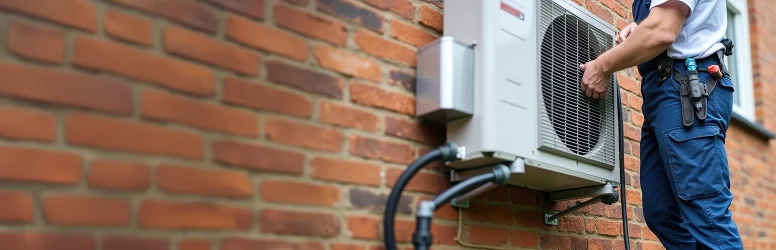
The conventional guidance on how often to replace an HVAC system goes something like this:
These are reasonable baselines for a system in a moderate climate with average usage, maintained on schedule. The problem is that millions of American homeowners don’t live in a moderate climate with average usage. They live in Phoenix, or Houston, or Minneapolis and the difference in system stress between those places and the median is substantial.
The better question isn’t “how old is my system” — it’s “how hard has my system been working, and what does my local failure data suggest about what’s coming.”
Climate is the biggest variable most homeowners don’t factor in when thinking about average HVAC lifespan by state. A central air conditioner running 3 months a year in Vermont is not the same machine as one running 9 months a year in Louisiana, even if they came off the same assembly line.
The key factors that climate adds to system wear:
In hot, humid southern states, planning for HVAC replacement at the 12-year mark rather than 15 is often the right call. In cooler northern climates with more moderate cooling seasons, systems can reasonably run closer to the 18–20 year range with proper maintenance.
The most concrete way to understand HVAC failure rate by climate is to look at actual breakdown data, not manufacturer estimates. Here’s what Liberty Home Guard’s claims data from January through September 2025 shows across our customer network.
In states where air conditioning carries the heaviest load, HVAC claims make up a disproportionate share of all home system failures. The ten states where HVAC claims represent the largest percentage of total service tickets in our network:
State | HVAC % of All Claims | Dominant System |
Iowa | 40.0% | Both AC & Heating |
Mississippi | 36.5% | AC-dominant |
South Carolina | 33.7% | AC-dominant |
Tennessee | 32.3% | AC-dominant |
North Carolina | 32.0% | AC-dominant |
Georgia | 31.9% | AC-dominant |
Louisiana | 31.9% | AC-dominant |
Kentucky | 31.3% | Mixed |
Alabama | 31.2% | AC-dominant |
Oklahoma | 29.5% | AC-dominant |
Source: Liberty Home Guard claims data, January–September 2025
Notice what almost all of these states have in common: they’re hot, they’re humid, and in most of them, air conditioning is running for more months per year than it’s resting. More operating hours produces more wear.
Nationally, air conditioning claims outnumbered heating claims by a ratio of 4.3 to 1 in the first nine months of 2025. That’s 8,110 AC claims versus 1,905 heating claims across our entire network.
In hot-climate states, the imbalance is even more pronounced. In Florida, AC claims outnumbered heating claims by more than 17 to 1. In Louisiana, the ratio was over 10 to 1. In contrast, colder states show a more balanced picture — Wisconsin was the only major state where heating claims actually exceeded AC claims, reflecting the different seasonal stress profile of genuinely cold-climate homes.
What this tells you is that if you live in the South or Southwest, your air conditioner is your most stressed system and your most likely replacement candidate. If you live in the Upper Midwest or Northeast, your furnace may deserve equal scrutiny.
Age is a starting point, not a verdict. These are the signals that move replacement from “something to think about” to “something to act on,” regardless of how old your system is:
One of the most common mistakes homeowners make when deciding whether to repair or replace is relying on a single quote from a contractor with a financial interest in the larger transaction. A second opinion from an independent technician, ideally one your warranty provider already works with, gives you a more objective picture.
Liberty Home Guard maintains a vetted technician network across all 50 states. A selection of the contractors we work with in the states where HVAC claims are highest:
These technicians are already integrated into our claims and service dispatch system, which means if you’re a Liberty Home Guard customer and your system fails, you’re likely to hear one of these names when we connect you with service in your area.
Understanding the real cost of replacement is the last piece of the decision. If you’re weighing a significant repair against replacement, you need a realistic number on the replacement side to compare against.
Typical installed cost ranges in 2025–2026:
Those numbers shift based on home square footage, duct condition, local labor markets, and whether your electrical panel needs upgrading to support a new system. Getting two or three quotes is always worth the time.
For a detailed breakdown of what drives these numbers, see our guides on air conditioner replacement cost and how much it costs to replace a full HVAC system.
The generic “15 to 20 years” rule is a starting point, not a strategy. Where you live, how hard your system has worked, and what your local repair and replacement data looks like are the variables that actually matter when it comes to when to replace your HVAC.
Based on our claims data, if you’re in the South, the Gulf Coast, or any climate where your air conditioner runs six or more months a year, the right planning horizon is shorter than the textbooks suggest. Systems in those climates are genuinely more stressed, and our service call volume in those states reflects it directly.
If you’re already seeing the warning signs like rising energy bills, inconsistent comfort and multiple repair calls, the decision is probably already made. The question is just whether you’re going to make it proactively or wait until it makes itself.
Liberty Home Guard’s HVAC replacement guide walks through every aspect of the replacement decision in detail including timing, cost, warranty coverage, and how to evaluate repair-versus-replace. And if you’re wondering whether your aging system is still worth keeping under a home warranty plan, our guide on home warranties and older HVAC systems answers that question.
When the day comes — and for most homeowners, it will — you’ll want a plan already in place.
Protect What’s Most Important With
Get A Free Quote
America’s #1 Home Warranty
Age matters less than the signs. If a single repair quote comes in at 50% or more of the cost of a new system, replacement almost always wins financially. Other red flags: two or more service calls in one season, rising energy bills over several years with no other explanation, uneven heating or cooling between rooms, and a system that still runs on R-22 refrigerant.
Yes, significantly. A central AC unit running 2,000–3,000+ hours a year in a hot, humid state logs far more wear than one running 500–900 hours in a cooler climate. Humidity accelerates coil corrosion and drainage issues, while extreme temperature swings and heavy dust or pollen loads add further stress on the compressor and blower motor.
The standard baseline is 15–20 years for central AC, furnaces, and mini-splits, and 10–15 years for heat pumps — but that assumes moderate climate and average use. In hot, humid states like Mississippi, Louisiana, or Georgia, planning for replacement closer to year 12 is often more realistic. In cooler northern states, systems can often run closer to 18–20 years with regular maintenance.
Based on Liberty Home Guard's claims data from January–September 2025, Iowa, Mississippi, South Carolina, Tennessee, and North Carolina had the highest share of HVAC claims relative to total service tickets — all at 30% or above. Hot, humid states with long AC-running seasons dominate this list.
Typical installed costs run $3,500–$7,500 for a central air conditioner, $3,000–$6,500 for a gas furnace, $4,000–$8,000 for a heat pump, and $5,000–$12,000 for a full system replacement (AC and furnace together). Actual pricing depends on home size, duct condition, local labor rates, and whether the electrical panel needs upgrading.
Stay Ahead of Potential
Home Mishaps!
Subscribe to our Liberty Home Guard Newsletter and gain access to exclusive content that ensures your peace of mind.

Subscribe to receive our emails & get
Have questions?
Call us: (833) 544-8273